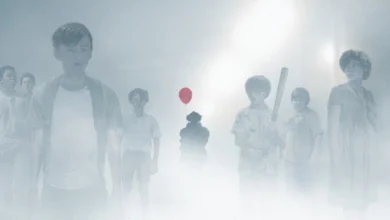
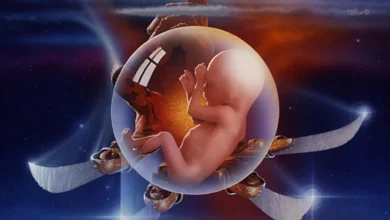
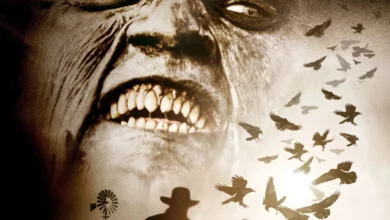
A scientist (Pierce Brosnan) loses his lab subject, a chimp. But he quickly finds a new one — the neighborhood imbecile, Jobe Smith (Jeff Fahey). After treatments of drugs and a virtual reality game, Jobe gains superhuman intelligence and verges on becoming a god. This is all fine and good until the government steps in and tries to find a way to turn Jobe into a weapon.
The most notorious thing about “The Lawnmower Man” is its origin. The rights to Stephen King’s short story were acquired as early as 1978 by Milton Subotsky (1921-1991), co-founder of Amicus, who wanted to make a horror anthology about machines. Over a decade later, with no film produced, the rights were bought from them in 1990 by Allied Vision Ltd. (a British company associated with Bob Shaye’s New Line).
A script came from writer-director Brett Leonard, whose previous credits include writing-directing the little-seen “Dead Pit” and acting in the cult classic “Killer Klowns From Outer Space”. Co-writer (and producer) Gimel Everett had wrote-produced “Dead Pit”, and interestingly enough worked in the art department for “Killer Klowns”. And to complete the trifecta is actor Jeremy Slate, who was also in “Dead Pit” as well as an earlier film Everett worked on, “A Whisper Kills”.
Leonard and Everett’s story had a small kernel that was vaguely related to the King tale. But they relied on the ideas of computer philosophy writer, computer scientist, and visual artist Jaron Lanier to create a tale of virtual reality mixed with “Flowers For Algernon”. The computer aspect is the crux of the film; it has nothing to do with the story, which revolved around a mythological creature.
King filed a lawsuit, which he ultimately won, and now his name is nowhere to be found in the credits. He was right to sue, and the judge was right to rule in his favor, because the finished product is quite obviously not a King story. Strangely, however, his grounds for suing were that the film would hurt his reputation. Considering all the terrible films with King’s name on them, this hardly seems realistic. (The lawsuit itself is an interesting saga, with New Line doing everything it could to ignore the court — from only hiding King’s name “a little” to sending replacement copies to retailers as slow as possible to guarantee an extra day or two of the King bumps.)
Despite the absence of King, this film is well-known and has been widely seen. Jeff Fahey is a cult star, and Pierce Brosnan was, well, the James Bond of the 1990s. Fahey was recommended because of his work in Eric Red’s “Body Parts” (1991) and it was thought he was about to become a major movie star. That stardom may not have happened, but he has gained a following. Pierce Brosnan was picked up at the right time, as he had not yet transitioned to film stardom from his TV success with “Remington Steele” (1982-1987).
But despite being a minor box office success, “The Lawnmower Man” has failed to stand the test of time, and has increasingly become a curiosity, ripe for cult status. Set just prior to the boom of the Internet (1994) and virtual reality, this film played on the fears of the Luddites and posited some possibilities that were, frankly, impossible. Maybe at the time they seemed likely, but now the ideas presented come across as largely silly.
How to discuss the special effects without being insulting? Watching this film in 2008 and again in 2017, the effects are really bad and makes much of the film seem cheap. Even for the time, as good as some of the effects were and how necessary they may be (such as the men unraveling), much of it just came off as childish. Why would virtual reality be a mix of video games and cubism? And the flaming priest scene… just failed in every respect. For a film about video games (or virtual reality) that crosses into reality, see “Brainscan”. The latter is gorier, scarier and really drives home a fear about technology (the alleged connection between video games and violence). “Lawnmower Man” tends to lose its message as the years go on and the Internet is more a part of our daily lives.
Despite its failings, the movie is still enjoyable and has a following. Fahey is a versatile actor (see Season Four of “Lost”) and it is nice to see Brosnan without a suit or muscles or with women hanging off him. He comes across as a normal, average guy. The themes presented are also interesting, though they do desperately need to be updated and the effects are better left ignored.
The Blu-ray from Scream! Factory is ridiculously packed. Not only do we have the theatrical cut, but also a director’s cut with an astonishing 38 minutes added back in. We have audio commentary, behind-the-scenes footage, vintage interviews and production photographs. There is conceptual art and storyboards, and best of all a new 50-minute making-of documentary called “Cybergod” that covers the film in detail and somehow manages to avoid mentioning Stephen King by referring to him only in veiled references.
My Score! - 58%
Plot and Storyline - 57%
Structure - 58%
Engagement - 56%
Plausibility - 57%
Acting and Performances - 61%
58%
This is dated but a classic dated movie. Before its time kind of movie. Pretty good for what it is.